 Market4Me
13 UGC Ad Ideas for Every Content Creator & Influencer
UGC ads convert best when they mimic organic content. The most effective ideas include problem/solution splits, green-screen reactions, and '3 reasons why' lists that avoid traditional sales tropes.
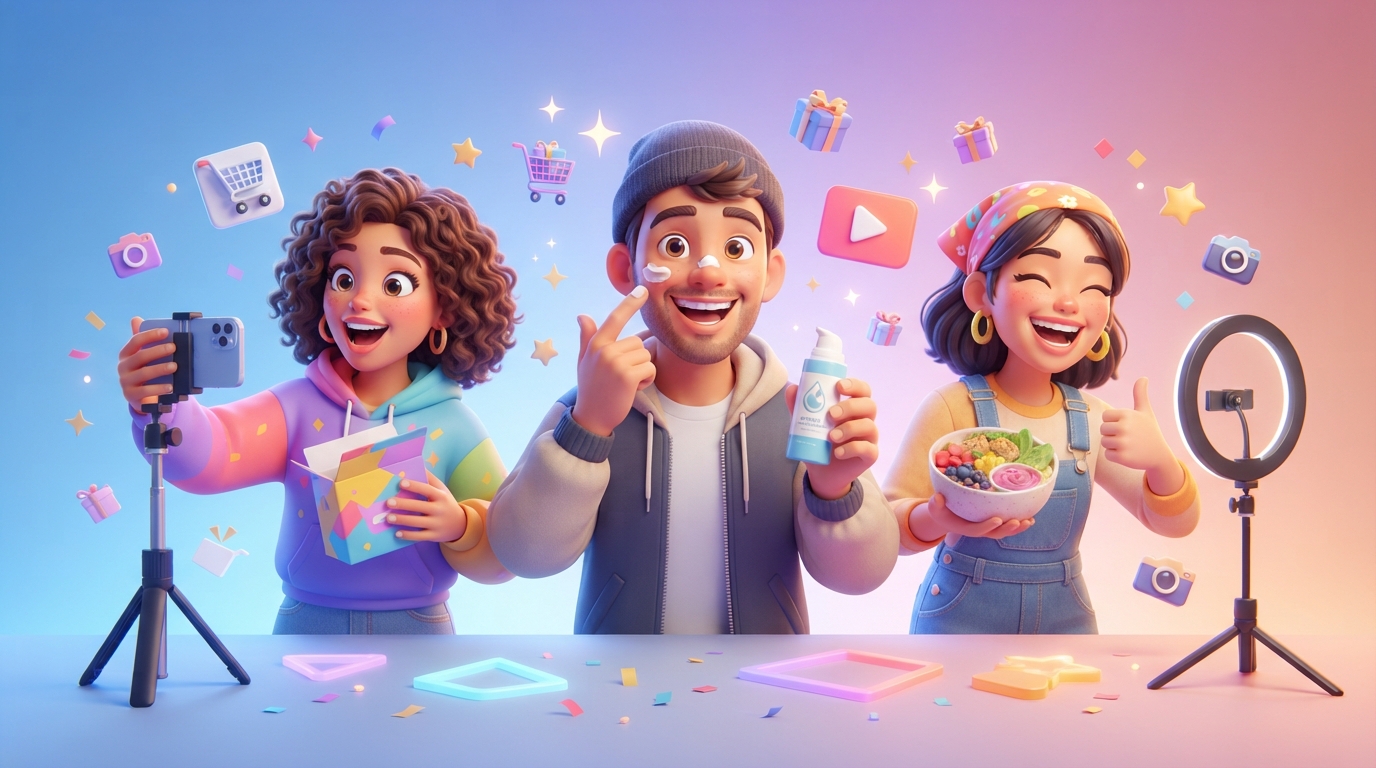
UGC ads convert best when they mimic organic content. The most effective ideas include problem/solution splits, green-screen reactions, and '3 reasons why' lists that avoid traditional sales tropes.
Key takeaways
- Effective UGC ads must pass the 'scroll test' by looking like organic peer-to-peer content.
- Hooks are the highest-leverage variable, often determining 80% of the video's success.
- Structure matters more than production value: use the Hook-Value-CTA framework for consistency.
High-performing user-generated content (UGC) ads are the backbone of modern social commerce. For a content creator or influencer, the challenge isn’t just making content; it’s making content that triggers a purchase without feeling like a commercial. To succeed, you need a library of reliable ugc ad ideas that can be adapted for any brand or niche.
Why UGC Ads Outperform Traditional Creative
Traditional studio ads often trigger ‘ad blindness.’ Users have been conditioned to skip anything that looks too polished or corporate. UGC works because it leverages social proof and the ‘friend-to-friend’ recommendation loop. According to TikTok’s Creative Center, videos that feel native to the platform see significantly higher engagement rates. For creators, this means your value lies in your ability to remain relatable while subtly directing the viewer toward a specific action.
13 High-Converting UGC Ad Ideas
1. The Problem/Solution Split Screen
Show the ‘struggle’ on the left or top and the ‘solution’ (the product) on the right or bottom. For example, if you are promoting a productivity app, show a cluttered, stressful desk versus a clean, organised digital workflow. This visual contrast provides immediate context without needing a single word of dialogue.
2. The ‘POV: You Found the Ultimate…’ Hook
Point-of-view (POV) content is inherently immersive. Start the video with ‘POV: You just found the only [Product Category] you will ever need.’ This frames the product as a discovery rather than a pitch. It works exceptionally well for fashion, home decor, and tech gadgets.
3. The ‘3 Reasons Why’ Listicle
Listicles are easy to consume. Use text overlays to count down three specific benefits. Be concrete: instead of saying ‘it’s fast,’ say ‘it saves me 45 minutes every morning.’ If you need help brainstorming these angles, a content idea generator can help identify the pain points your audience cares about most.
4. The Green Screen Reaction
Use the green screen filter to react to a brand’s website, a specific customer review, or a news article related to the product. This format allows you to provide expert commentary as an influencer while keeping the product or data front and centre. It feels like a ‘breakdown’ rather than a scripted ad.
5. The ‘A Day in the Life’ Integration
Rather than focusing solely on the product, show it as a natural part of your routine. If it’s a supplement, show yourself taking it before a workout. If it’s software, show it open on your laptop during a ‘work with me’ segment. This builds ‘usage association’ in the viewer’s mind.
6. The Close-Up Honest Review
Film in a non-studio setting—like your car or your kitchen—with the camera close to your face. Speak at a lower volume to create a sense of intimacy. Start with: ‘I wasn’t going to talk about this, but…’ This ‘confessional’ style builds immense trust.
7. The ‘Old Way vs. New Way’ Comparison
Physically demonstrate the difficulty of the ‘old way’ of doing things. If it’s a kitchen tool, show the mess of manual chopping versus the speed of the product. This creates a logical ‘bridge’ for the consumer to follow. You can find more specific examples in our guide on how to make product videos for TikTok.
8. The ASMR Unboxing
Focus entirely on the sensory experience. The sound of tearing tape, the ‘click’ of a lid, the texture of the fabric. ASMR (Autonomous Sensory Meridian Response) videos have high retention rates because they are satisfying to watch. This is perfect for high-quality physical goods.
9. The ‘Stitch’ or Response Style
Start your video by ‘responding’ to a common question or a trending video in your niche. ‘I keep seeing people ask how to [solve problem], and I finally found the answer.’ This positions the product as the hero of the narrative.
10. The Step-by-Step Tutorial
Educational content is highly shareable. Show exactly how to use a feature that most people overlook. For instance, if you are using an AI UGC generator, show the 30-second process of turning a URL into a video. People love ‘how-to’ content because it provides immediate value.
11. The ‘Life Hack’ Reveal
Frame the product as a ‘hack’ that people don’t know about yet. ‘Stop doing [X] and start doing [Y].’ This plays on the fear of missing out (FOMO) and the desire for efficiency.
12. The Aesthetic Montage with Voiceover
Combine 5–10 short clips (0.5 to 1.5 seconds each) of the product in use, set to trending audio or a calm voiceover. This is about ‘vibe’ and brand alignment. It works best for lifestyle, travel, and luxury brands.
13. The ‘Wait, Don’t Scroll’ Pattern Interrupt
Use a physical or visual pattern interrupt in the first 2 seconds. Drop something, use a loud sound, or start with a controversial statement. Once you have their attention, pivot immediately into the product benefit. Using a hook generator can help you find the right opening line for this aggressive style.
The UGC Ad Performance Framework
To ensure your ugc ad ideas actually convert, you must follow a structured framework. Randomly filming will lead to inconsistent results. Use the table below to plan your next creative batch.
| Element | Purpose | Target Duration | Key Metric |
|---|---|---|---|
| The Hook | Stop the scroll | 0–3 Seconds | 3s View-Through Rate |
| The Problem | Agitate the pain point | 3–8 Seconds | Retention Rate |
| The Solution | Introduce the product | 8–15 Seconds | Engagement Rate |
| The Proof | Show it working/Results | 15–25 Seconds | Click-Through Rate |
| The CTA | Tell them what to do | 25–30 Seconds | Conversion Rate |
Technical Best Practices for Creators
- Lighting: Natural light is usually better for UGC than professional softboxes. It looks more authentic.
- Audio: Clear audio is non-negotiable. Use a lapel mic or ensure you are in a quiet room. If the audio is bad, the ad will fail, no matter how good the visual is.
- Captions: 80% of social media users watch videos on mute. Always use high-contrast, easy-to-read captions. If you are managing multiple accounts, consider how to automate your content calendar to handle the volume.
- Native Fonts: Use the fonts and stickers native to the platform (TikTok, Reels, or Shorts) to make the ad feel like an organic post.
Scaling Your UGC Production with AI
As a content creator, your time is your most valuable asset. Filming 30 unique UGC ads a month is exhausting and often leads to burnout. This is where Market4Me.ai steps in. By using our AI video marketing platform, you can generate high-quality, brand-aware short-form videos without needing to set up a camera every single day.
You can even create a consistent AI influencer that acts as the face of your brand, ensuring that your UGC ads have a recurring, recognisable persona. This allows you to test dozens of ugc ad ideas simultaneously to see which one resonates best with your target audience.
Common Pitfalls to Avoid
- Being too ‘Salesy’: If you sound like a late-night infomercial, people will swipe. Keep it conversational.
- Ignoring the First 3 Seconds: If the hook is weak, the rest of the video doesn’t matter. Spend 50% of your time on the hook.
- Vague CTAs: Don’t just say ‘check it out.’ Say ‘Click the link in my bio to get 20% off today.’
- Over-editing: Fast cuts are good, but over-produced graphics can make the content feel like a ‘brand ad’ rather than a ‘creator post.’
Ready to stop trading all your time for content? Start your journey with Market4Me.ai and see how AI can take your UGC strategy from manual to autopilot. For more inspiration, check out these 15 short-form video ideas to keep your feed fresh.
Put your marketing on autopilot
Paste your URL and let Market4Me.ai build, schedule and post your content for you.
Start free →Frequently asked questions
What is the best length for a UGC ad?
The sweet spot is typically between 15 and 30 seconds. While platforms allow longer, retention usually drops significantly after the 30-second mark unless the content is highly educational or entertaining.
Do I need professional equipment for UGC ads?
No. In fact, high-end production can often hurt performance. A modern smartphone with good natural lighting and a simple microphone is usually sufficient to create content that feels authentic.
How many hooks should I test for one ad?
We recommend testing at least 3 different hooks for every 1 'body' of an ad. Small changes in the first 3 seconds can lead to a 2x or 3x difference in total performance.
Can I use AI to create UGC ads?
Yes. Tools like Market4Me.ai allow you to generate UGC-style videos using AI influencers and automated scripts, which is ideal for creators looking to scale without increasing their filming time.
What is the difference between organic UGC and a UGC ad?
Organic UGC is created by fans for fun. A UGC ad is commissioned content designed with a specific marketing objective and call-to-action, usually distributed via paid social channels.