 Market4Me
What Is an AI Content Calendar? (2026 Strategy Guide)
An AI content calendar is an active marketing system that generates, schedules, and optimises social media posts using brand data, rather than just storing manual entries.
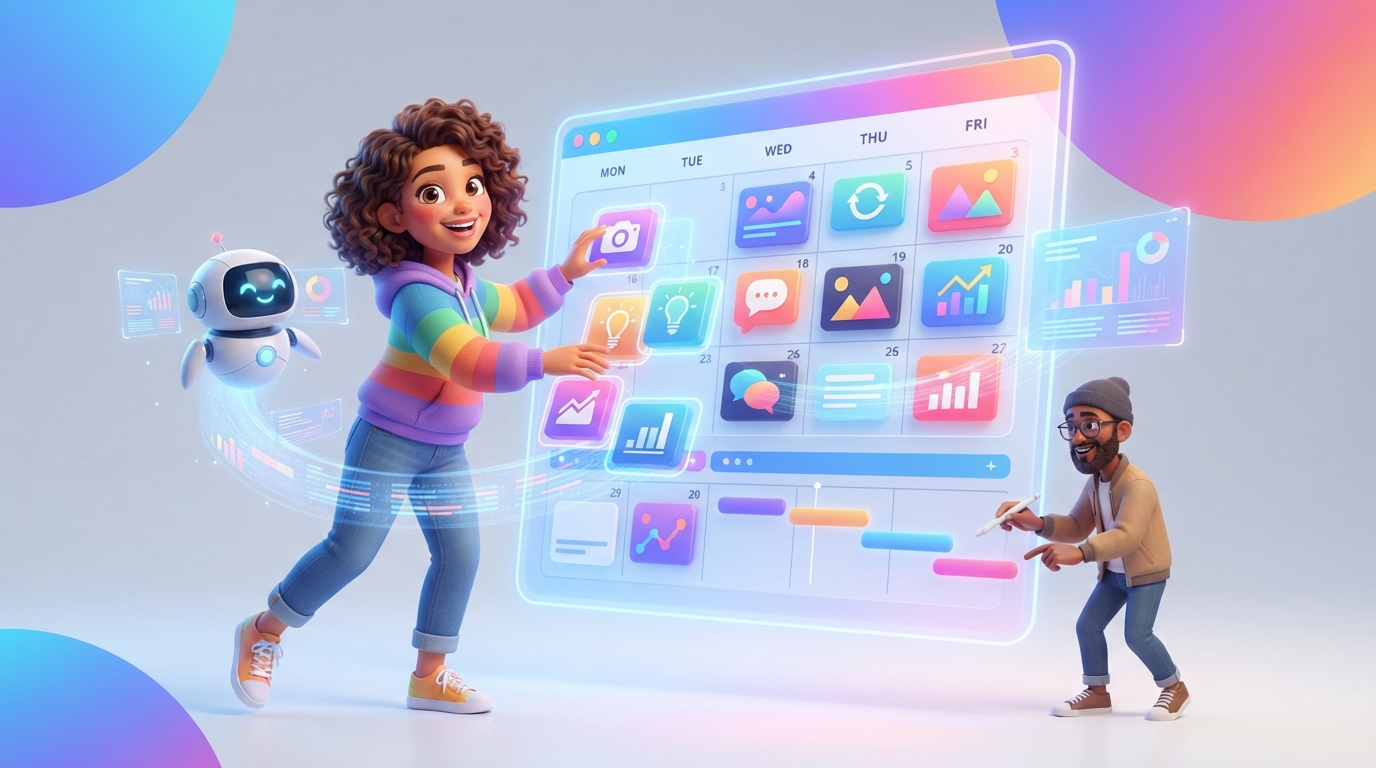
An AI content calendar is an active marketing system that generates, schedules, and optimises social media posts using brand data, rather than just storing manual entries.
Key takeaways
- An AI content calendar actively generates and optimises content instead of just storing manual plans.
- The system works by analysing brand assets (like websites) to maintain consistent voice and pillars.
- A hybrid human-in-the-loop review queue prevents brand drift while maintaining high posting volume.
- Modern AI calendars can produce and schedule complete short-form video assets on autopilot.
Demystifying the AI Content Calendar: A Clear Definition
For years, a “content calendar” was nothing more than a passive storage grid. Whether it lived in a spreadsheet, a Trello board, or a legacy scheduling tool, it relied entirely on human input. You had to come up with the ideas, write the copy, design the assets, set the date, and manually schedule the post.
An ai content calendar represents a fundamental operational shift. It is an active, generative system. Instead of waiting for your input, it uses machine learning and brand-aware algorithms to analyse your product, define content pillars, write scripts, generate visual assets (including short-form video), and schedule posts autonomously.
By connecting directly to your brand’s digital footprint, an AI content calendar changes your role from creator to editor. You no longer stare at a blank screen wondering what to post on Tuesday; instead, you open a fully populated queue of ready-to-publish assets and decide which ones get the green light.
Traditional vs. AI Content Calendars: The Operational Shift
To understand why this shift matters, we must look at how marketing teams actually spend their time. Traditional social media management is heavily administrative. Creative production takes hours, but scheduling, formatting, and coordination take just as long.
| Operational Feature | Traditional Content Calendar | AI Content Calendar |
|---|---|---|
| Ideation | Manual brainstorming sessions, competitor analysis, keyword research. | Automated analysis of your website, industry trends, and historic performance. |
| Asset Creation | Copywriters write text; designers/editors build graphics and videos. | AI models generate captions, graphics, scripts, and complete vertical videos. |
| Scheduling | Drag-and-drop manual calendar entries with manually selected times. | Algorithmically optimised posting times mapped to platform-specific trends. |
| Consistency | Highly vulnerable to human bottlenecks, creative block, and resource limits. | Predictable, infinite pipeline that maintains a daily cadence automatically. |
| Platform Formatting | Manual resizing and rewriting for TikTok, Reels, and YouTube Shorts. | Automatic conversion of core concepts into platform-specific aspect ratios and styles. |
Transitioning to an automated system is the core focus of What Is Content Automation? Your 2026 Guide to Efficiency, which outlines how local businesses and growing startups bypass the overhead of traditional agencies.
How an AI Content Calendar Actually Works
An enterprise-grade AI content calendar does not simply spit out generic motivational quotes or stock images. It runs on a structured, multi-step pipeline designed to mimic a professional marketing agency.
1. Brand Ingestion and Analysis
The process begins by establishing context. The AI crawls your website URL, documentation, or product pages to learn exactly what you sell, who your target customer is, and what tone of voice you use. It extracts your core value propositions so it never creates content that feels disconnected from your actual offering.
2. Strategy and Pillar Generation
Once the brand profile is built, the system establishes specific content pillars. For example, a B2B SaaS tool might have pillars for “Productivity Hacks,” “Feature Deep Dives,” and “Industry Counter-Intuitive Insights.” This structure ensures your calendar maintains a healthy, strategic balance rather than repeating the same sales pitch.
3. Creative Asset Production
This is where the magic happens. Instead of just scheduling text, an integrated AI video marketing platform generates high-engagement media assets. It writes a video script, pairs it with background footage or an on-screen AI influencer, overlays captions, and compiles a finished video ready for distribution.
4. Smart Scheduling and Publishing
The calendar analyses platform metrics to determine when your specific audience is most active. It queues the posts across your connected channels (TikTok, Instagram, YouTube, Facebook) and handles the publishing via official developer APIs.
Integrating Video Assets and AI Influencers
In 2026, text and static image posts are no longer enough to build a meaningful social presence. The algorithmic feeds of TikTok, Instagram Reels, and YouTube Shorts prioritize vertical video.
Historically, running a video-first content calendar was incredibly expensive. It required camera gear, lighting, editors, and on-camera talent. An AI content calendar solves this by integrating automated video generation directly into the workflow.
By leveraging tools like an AI TikTok generator or an AI Instagram Reel generator, the system can populate your calendar with high-quality vertical videos that look like they were produced in a studio.
Furthermore, you can lock in a consistent on-screen persona using an AI influencer generator. This ensures that even though your content is generated programmatically, your audience sees a familiar face in every video, building brand trust and recognition over time. To understand how this fits into a broader video strategy, refer to What Is Short-Form Video Marketing? Your 2026 Guide.
Strategic Trade-offs: When to Automate and When to Intervene
While the technology behind autonomous marketing has advanced rapidly, 100% hands-off automation without human oversight is a mistake. Brand safety, accuracy, and real-time cultural relevance still require a human touch.
The most successful brands use a hybrid workflow often referred to as “human-in-the-loop.”
- Let the AI handle: High-volume ideation, draft scripts, first-pass video rendering, caption generation, hashtag research, and the mechanics of scheduling.
- Keep humans in control of: Final editorial approval, verifying factual accuracy (especially in highly regulated industries), responding to comments, and injecting highly time-sensitive news or real-world events into the feed.
By using a swipe-to-approve interface, a founder or marketing manager can review a week’s worth of generated videos in under five minutes. You maintain absolute control over what goes live on your channels while eliminating 95% of the manual labor.
Setting Up Your First Autonomous Content Workflow
If you are ready to move away from spreadsheets and start scaling your social media presence, follow this step-by-step implementation guide.
- Define Your Goals and Channels: Decide where your audience lives. If you sell B2B, focus on YouTube Shorts and Instagram. If you are an e-commerce brand, TikTok and Reels are your primary drivers.
- Connect Your Brand Assets: Input your website URL into your AI marketing tool. Let the system crawl your landing pages, blog posts, and documentation to build its baseline understanding of your product.
- Review the Generated Strategy: Before letting the AI write content, audit the content pillars and hooks it proposes. Ensure they align with your business objectives.
- Set Your Posting Frequency: Determine your weekly volume. A typical starting point is 3 to 5 short-form videos per week. Your monthly credit allowance will dictate your output capacity (for example, on Market4Me.ai, a Starter plan provides ~30 videos per month).
- Establish a Review Routine: Block out 10 minutes every Monday morning to review the generated queue. Approve the winners, edit any scripts that need a personal touch, and regenerate the ones that don’t hit the mark.
To see how this looks in practice for a business builder, explore The Founder’s Guide to Marketing on Autopilot, which details how to step away from the daily content creation grind while actually increasing your organic reach.
Scale Your Content Operation with Market4Me.ai
Staring at a blank content calendar is a massive drain on your creative energy and time. Market4Me.ai turns your website URL into a fully autonomous marketing machine.
From brand analysis and strategy mapping to scriptwriting, vertical video generation, and automatic publishing, Market4Me.ai handles the heavy lifting of social media management. You get a predictable, consistent flow of high-quality short-form videos without the price tag or administrative hassle of a traditional agency.
Ready to put your social media growth on autopilot? Get started with Market4Me.ai today.
Put your marketing on autopilot
Paste your URL and let Market4Me.ai build, schedule and post your content for you.
Start free →Frequently asked questions
What is the difference between a traditional social media calendar and an AI content calendar?
A traditional calendar is a passive storage grid where you manually input text, upload media, and set times. An AI content calendar actively generates post ideas, writes scripts, creates media assets (like short-form videos), and schedules them autonomously based on your brand guidelines.
Can an AI content calendar write and schedule videos?
Yes. Advanced platforms can generate video scripts, render vertical videos using AI influencers or product b-roll, draft captions, and queue them directly to platforms like TikTok, Instagram, and YouTube Shorts.
Do I lose control over what gets posted on my brand accounts?
No. Reliable AI content calendars feature a 'review and approve' queue. You can swipe, edit, or regenerate any asset before it goes live, ensuring your brand safety remains intact.
How does an AI calendar know what my brand voice sounds like?
The system crawls and analyses your existing website URL, product descriptions, and target audience data. It then establishes content pillars and tone rules to ensure every output matches your natural brand voice.
Does using an AI calendar violate social media platform rules?
No. Publishing via official developer APIs (like those provided by Meta, TikTok, and YouTube) is fully compliant with platform terms of service and does not negatively impact organic reach.